Canalblog Tous les blogs Top blogs Littérature, BD & Poésie
Suivre ce blog Administration + Créer mon blog
MENU

Art You Should Know

Publicité
8 avril 2025

Little Black Sambo, illustrated by Florence White Williams

Little Black Sambo by Helen Bannerman, illustrated by Florence White Williams

This story about a boy and four (!) tigers was written in 1899 and became an instant hit. It went through numerous reprints and corrections, including censoring and banning.

We will summarize the already short and simple story with illustrations by Florence White Williams. This version was published in 1922 by Saalfield Publishing Company, Chicago, Akron (Ohio), New York, and is still considered racist.

Nevertheless, the majority agree that the story is very charming and not offensive. The problem is only with illustrations. Still, the story is easier to follow and way more memorable if the pictures are involved.

Once, there was a black boy called Little Black Sambo. His mother was Black Mumbo.

His father was Black Jumbo.

Mother gave Sambo a pair of blue trousers and a beautiful red coat.

Little Black Sambo was very happy. Especially when his father bought him a green umbrella.

He decided to put all his best clothes on and walk into the jungle.

There, he met a tiger.

The tiger wanted to eat Little Black Sambo. But the boy convinced him to spare his life in exchange for his red coat.

The tiger loved the coat. He felt the grandest tiger in the jungle.

Little Black Sambo continued his walk until he met another tiger.

This tiger wanted to eat Little Black Sambo, too. Yet the boy had a solution: he traded his pair of blue trousers for his life.

The tiger was delighted with his new piece of wardrobe. The first piece of wardrobe, actually.

Little Black Sambo continued without a coat and trousers. Not long after, he met a third tiger. Guess what? His plan was the same: to eat the boy.

The boy offered his shoes to the third tiger, and he could continue. Bare-footed and alive.

The tiger was very proud of his shoes. He believed he was the best-looking tiger in the world.

How about Little Black Sambo? Believe it or not, he met another tiger. He intended to eat the boy as well.

The kid was out of clothes. He offered his umbrella in exchange for his life. The tiger hesitated. He liked the umbrella, but he couldn't grab it like a human or put it on like other tigers did with the clothes and shoes.

It took some time before Little Black Sambo showed the tiger how to carry an umbrella. True, the beast couldn't grab it with the paws.

Still, it could tie a knot on the tail and carry the umbrella!

There was a very proud tiger and a very alive little boy! (Crying, though, because he was without any clothes.)

So Little Black Sambo continued with his walk through the jungle.

Suddenly, he heard roaring. He recognized tigers. Not one or two - all four tigers were roaring. Little Black Sambo escaped to the top of the palm tree.

He saw all four tigers arguing about their appearance. Everybody claimed he was the best-looking tiger in the jungle! They started fighting.

Each of the tigers bit one of the other tigers by the tail, so they formed a circle around a tree. They were moving so fast that only a mix of yellow fur and black stripes was visible. Their clothes fell off.

Little Black Sambo climbed down and took back his coat, his trousers, his shoes, and his umbrella.

He put everything back on while the tigers were still roaring and chasing each others' tails.

They soon became unrecognizable. Sometime later, they melted into ghee!

Little Black Sambo came home just in time when his father, Black Jumbo, brought a pot of ghee. He has found it under the tree. It looked somehow similar to tigers' furs.

Black Mumbo made a huge batch of pancakes. Everybody ate them. They were so good!

This is the end of Little Black Sambo. The story is quite good. We can still find it 100% relevant when we talk about bullying, a constant problem in our world. As we already said, the illustrations by the original author Helen Bannerman, who wrote and illustrated it, were considered inappropriate, and Florence White Williams' pictures were not valued much higher.

To avoid controversy, we would like to point your attention to her other work, probably even more popular than Little Black Sambo. Check Florence White Williams' illustrations of Little Red Hen!

And, please, think how you can use the good parts of this immortal story without disturbing your audience!

Publicité
10 octobre 2024

Bookplates by Jesie Marion King

12 Bookplates by Jesie Marion King with Comments

A bookplate is a decorative sheet used to mark ownership of one's book. In most cases, it's stuck at the front of the book, stuck at the inner front, or the flysheet, but it can also be used to mark the position where the reader made a pause. Bookplates have been used since the 15th century and often have the Latin sign Ex Libris, which means 'from library'.

Jessie Marion King was just one of numerous artists who created decorative bookplates for very different clients. Many of them liked to include a quote just like the nobility (which was rapidly falling out of fashion due to the rise of the bourgeois class) used to have a motto in the coat of arms. At the beginning of the 20th century, the creation of bookplates was so popular that it became an art and even a business on its own, providing small yet important auxiliary income for artists who could spend a lot of time on a specific commission before they got paid. On the other hand, a bookplate was created relatively fast, with a minimum amount of materials, and the possibility of the client going bankrupt before the order was finished was infinitesimal. The beneficial side effect of a bookplate was that it worked as a kind of business card promoting the creator to every reader who got the book with this bookplate in their hands.

Bookplates by Jessie M. King are important for many reasons. They are aesthetic, present her unique take on Art Nouveau with the influence of Arts & Crafts and Pointillism, and they are true documents of the time. This post is dedicated to Jessie Marion King's Ex Libris with twelve original works, and we hope to provide even more in the future. Enjoy these small but powerful decorative labels!

This bookplate is probably the most well-known ex-libris by J. M. King. It was created around 1906 for Fred J. M. Christi, a textile merchant from Glasgow. The center of the scene is occupied by two readers and a Sphynx. The border is composed of human figures, birds, and flowers. 'Ars Longa Vita Brevis' roughly translates as 'Skillfulness takes time and life is short'.

This bookplate is printed in black, blue, and gold on cream paper and the originals are worth a few hundred dollars each.

The bookplate for Charles D. Edwards is a black-and-white ink drawing on paper (Japanese vellum) in dimensions 14 cm x 11 cm. On the top, we can read 'That Man's Unwyse Wille Searche for Ille and Maye Prevent it Setting Stille'. The picture presents a ship with furled sails. At the back of the ship sits a girl with curly hair.

Ex-libris for Vera L. Holme is made in the same style and with the same dimensions as for Charles D. Edwards. 'O Freedom Beautiful Beyond Compare Thy Kingdom Is Established'. This plate was created in 1918. According to preserved letters, Vera Holme was J. M. King's personal friend. When J. M. King accepted the commission, adding that she was afraid her work may be too expensive.

'Illusive Goddess of the Woods of Wisdom' is the quote on the bookplate for Jim King, presenting a goddess in the woods searching for wisdom. Two figurines provide the side pillars of the border. The border is finished by vertical lines at the top and at the bottom of the picture. We don't know who was Jim King, but the fact his bookplates were printed in colors suggests he was wealthy.

'Quit Like Men. Be Strong.' says the bookplate for David Macmyn. Was he the famous surgeon and rugby player?

A ship is sailing by the ruins of the castle. Four angels are placed at the corners. This is a monochromatic black print on woven paper (paper pulp applied on wire cloth). 'Paciencia y baraiar' roughly translates to 'Don't give up, keep trying!'.

Amy Olivia Paet was the daughter of Lord Alfred Henry Paget. She lived most of her life in the castle in France, which is portrayed in the bookplate. The words 'Gloria Deo in Excelsis' can be translated as 'Glory to God in the highest'. The design was created around 1903.

We don't know where to place Mary Elizabeth Reid. J. M. King, in this case, used four butterflies instead of four angels for four corners.

Ernest Archibald Taylor, who was mostly signed as E A Taylor, was a Scottish successful artist and designer. He painted in oil and watercolor, designed furniture and stained glass, but most important of all, he married J. M. King and fathered their only child - Merle.

James H. Young is another mystery to us. 'Semper Juvenus', of course, means 'Always youthful'.

That's it for now.

If you like bookplates, here are a few interesting ones by J. M. King's contemporary from Germany: Franz Stassen.

If you would like to see more of J. M. King's works, here are a few of her unique postcards.

Don't forget to bookmark this page and have a great time!

30 septembre 2024

Hansel and Grethel

Hansel and Grethel, a Fairy Tale by the Grimm Brothers

Illustrated by Franz von Pocci nad Leopold Vollinger

The book was published by Sebaldus-Verlag, Nurnberg in 1944

The illustrations are signed by Franz Graf von Pocci (1807-1876) and Leopold Vollinger (1818-1869).

There is a famine in the country. People die of hunger every day. A poor woodcutter has almost no food in the house. He has two kids - Hansel and Grethel.

Their mother died, and the woodcutter remarried. Hansel and Grethel are good children but always hungry. Just like almost everybody else.

One evening, Hansel overhears a conversation between his father and stepmother.

She wants to take children in the woods. They will be left there to die. This way, the woodcutter and his wife will have more chance to survive.

Hansel is worried. He doesn't want to die in the woods. He wants to protect himself and his sister.

A walk the brook gives him an idea. There are many shining white pebbles. He can mark the way from his home to the woods with them!

The kids are really left in the woods.

But they find a way home thanks to the shiny lead of the pebbles.

Still, the stepmother is not giving up. She wants to take Hansel and Grethel into the woods again. This time, even deeper.

Hansel is worried again.

In the evening, he can't get out for more pebbles. The doors are locked.

The journey into the woods starts for the second time. Hansel secretly drops the crumbles of his only piece of bread.

But the birds eat the bread crumbs. The kids are lost. They can't find back home.

They wander around the woods until they find an unknown house. A nice lady invites them in.

Hansel and Grethel get some food. They don't know that the old lady is a cannibalistic witch who plans to eat them.

Hansel is locked in a cage, and Grethel has to work as a maid.

The witch orders her to prepare an oven. She sends Grethel into the oven to check if it's hot enough. But Grethel pretends she doesn't understand how to get into the oven. The witch is ready to show her.

Grethel pushes the witch into the oven and the old cannibal burns. Grethel opens the cage and frees Hansel.

The kids find all kinds of treasures in the witch's house. They can return home rich. There will be no more hunger!

A duck helps them to get home, where they find their father alone. The kids' stepmother died in the meantime. Justice is served!

The illustration by Pocci and Vollinger is a bit strange for today's taste. We need to know that printing with wood engravings wasn't easy in the 19th century (we are dealing with a reprint of the original in this post), but artists found many ways to create beautiful pictures with numerous details. Still, Pocci and Vollinger obviously opted for the simplified illustration, which in many aspects looks like being done by kids. Their work was quite popular.

If you like vintage illustrations, there are a few other artists who also illustrated Hansel and Grethel. Compare their style and enjoy:

Gilbert Penrose James' style is the most similar to the already presented:

https://gilbertpenrosejames.weebly.com/hansel-and-gretel.html

Franz Stassen was known for his line drawing:

https://franz-stassen.mystrikingly.com/blog/hansel-and-gretel

Carl Offterdinger was one of the most popular artists from the second half of the 19th century.:

https://carl-offterdinger.dorik.io/hansel-and-gretel

Charles Robinson was one of the masters who defined the Art Nouveau style:

https://charlesrobinsonillustrator.blogspot.com/2024/04/hansel-and-gretel.html

If you like vintage illustrations, please share this post with your friends and help to preserve art from our past. It's the essence of our present and a cornerstone of our future. Thank you very much!

4 août 2024

Young Pilgrims with illustrations by E. S. Hardy

The Young Pilgrims by Charles Herbert, illustrated by Evelyn Stuart Hardy

The Young Pilgrims is a historical children's book about the Pilgrims. It was a pretty popular book at the beginning of the 20th century, considering numerous reprints in the UK and the USA. It was published by John F Shaw & Co Ltd, London, 1910, and by Lippincott, Philadelphia, 1915 among others.

Our presentation is built on the 1920 reprint by Lippincott. There is close to zero data about Charles Herbert, the author of the book, but we'll focus on E. S. Hardy's illustrations. She is uncredited in the book, by the way. While we can be sure about her authorship of the color plates, some of the black-and-white drawings may be done by somebody else. Some are signed, some are not, and some signatures are questionable.

However, we'll skim through the book with color images only.

The story starts with a family of four. Father has troubles with the law and this impacts all family members. Mother can hardly get a job, and both children are worried about the future. The main problem is their religion which is not in tune with official rules. The father comes with the idea of finding a new life in New England.

This means a lot of dangers and a complete reset of their lives. But it also means a chance to make significant improvements in their life circumstances, while staying at home can only mean going from bad to worse. Other family members, especially his wife, are not very enthusiastic about the idea, but, eventually, they prepare to move to Holland where the ship Mayflower is waiting.

Initially, the Pilgrims planned to sail with two ships, but they went with the Mayflower only.

During the voyage, hard decisions had to be made.

Winter was harsh and dangerous.

Supply ships were of existential importance for the colonists.

A new community had been formed.

Every member had to participate and Pilgrim women were hard workers.

Eventually, New England became the new home to millions of people from Europe.

Pilgrims and Native Americans helped each other with their unique knowledge.

Yes, this is how the USA was built.

Through the personal story of a fictional family, we learn many facts about life in the 17th century. England's Church was going through numerous changes, which were not always welcomed by the believers. Some persisted with the authorities, some demanded reforms, and some simply decided to go away and have a start fresh start. While Puritans tried to induce reforms, Separatists went to Holland, where they had almost complete religious freedom. However, a chance to settle in the New World, made some of them cross the Atlantic, and the family introduced at the beginning of this book was among 102 passengers (there were about 30 crew members, too) who decided to establish a colony of Plymouth in today's Massachusetts.

Less than half of the Pilgrims survived the first winter. Even they would probably perish if there were not  Wampanoag Native American people, who taught them how to gather food and protect themselves against numerous natural dangers. This connection resulted in today's celebrated Thanksgiving, a great family festival, where the main idea is to gather the family members at a feast, which typically lasts more than one day ('original' Thanksgiving lasted three days) and express gratitude to be alive, to be healthy, to be with friends, etc.

E. S. Hardy created great pictures for the presented book, which can today serve more as an educational tool than a literary achievement. All the graphic materials are in the Public Domain and can be freely used for just about everything. If you are looking for inspiration for Thanksgiving decor, this is certainly one way to go. If you need something funnier, vintage Thanksgiving postcards by W. W. Denslow, her contemporary from the USA, are another possibility. Just don't forget - Thanksgiving Day is all about spending quality time together and cherishing family values.

11 août 2023

The Tale of Jemima Puddle-Duck by Beatrix Potter

This story features a white duck (yes, she is a duck, not a goose!) who has only one wish - to be able to lay her own eggs. Let's see how Beatrix Potter tells about her adventures - by her words and her illustrations.

jemima-puddle-duck-beatrix-potter-frontispiece


The book was published in 1908 by Frederick Warne & Co., Inc., London, New York.

jemima-puddle-duck-beatrix-potter-vignette

Jemima lived at the farm with some hens. Her major problem was the farmer's wife.

jemima-puddle-duck-beatrix-potter-picture-01

She took all Jemima's eggs but the duck wanted to hatch them.

jemima-puddle-duck-beatrix-potter-picture-02

Jemima tried to hide her eggs, yet they were always found and taken.

jemima-puddle-duck-beatrix-potter-picture-03

So Jemima Puddle-Duck decided to make her own nest somewhere away from the dangers of the farm.

jemima-puddle-duck-beatrix-potter-picture-04

Why not try to use the safety of the trees in the wood?

jemima-puddle-duck-beatrix-potter-picture-05

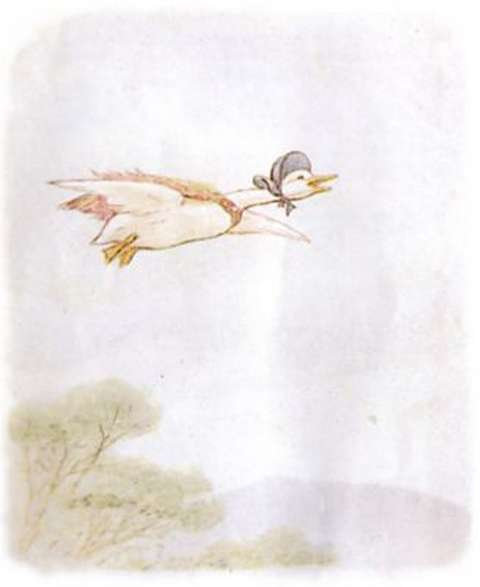
She could fly there ...

jemima-puddle-duck-beatrix-potter-picture-06

She just needs a good start.

jemima-puddle-duck-beatrix-potter-picture-07

She flew across the trees and decided to land on the open spot in the middle.

jemima-puddle-duck-beatrix-potter-picture-08

She looked among the flowers and thought there would be a nice place for her nest.

jemima-puddle-duck-beatrix-potter-picture-09

But there was somebody already there. A gentleman reading newspaper.

jemima-puddle-duck-beatrix-potter-picture-10

He was very helpful. The gentleman offered her to use his woodshed. It was already full of feathers.

jemima-puddle-duck-beatrix-potter-picture-11

The gentleman let her in.

jemima-puddle-duck-beatrix-potter-picture-12

There were really a lot of feathers.

jemima-puddle-duck-beatrix-potter-picture-13

Jemima started nesting right away. It was quite comfortable.

jemima-puddle-duck-beatrix-potter-picture-14

The gentleman was waiting outside and looked a bit disappointed when she went home.

jemima-puddle-duck-beatrix-potter-picture-15

He promised he'll look at the eggs while she was gone.

jemima-puddle-duck-beatrix-potter-picture-16

She returned every day until nine eggs were in the nest. The gentleman asked her to bring some herbs next time so he could make an omelet.

jemima-puddle-duck-beatrix-potter-picture-17

Jemima did her best to provide the gentleman with everything for stuffing roast duck.

jemima-puddle-duck-beatrix-potter-picture-18

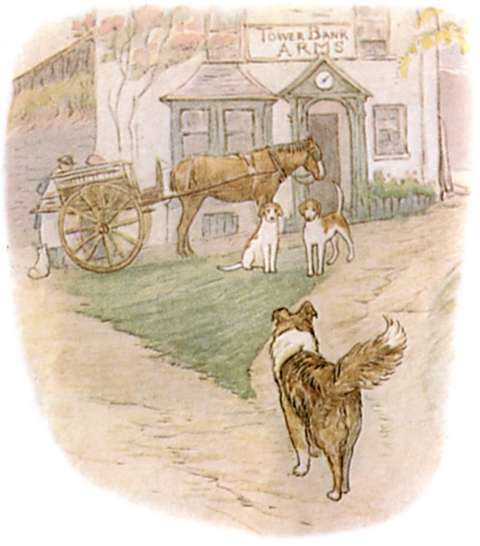
In the kitchen, a collie stopped her and asked where is she going every day and why she needs onions. When she described the gentleman, the dog became angry.

jemima-puddle-duck-beatrix-potter-picture-19

He asked about the location of the shed in the wood. Then he invited two fox hounds to join him.

jemima-puddle-duck-beatrix-potter-picture-20

In the meantime, Jemima went towards the shed as well. She had a lot to carry.

jemima-puddle-duck-beatrix-potter-picture-21

The gentleman was waiting for her. He ordered her to go into his house right after she check the eggs. She was surprised by his rudeness.

jemima-puddle-duck-beatrix-potter-picture-22

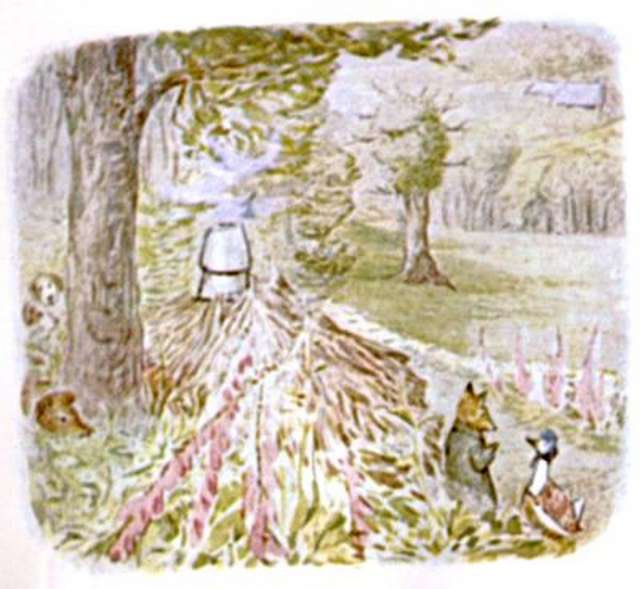
While she was in the shed she heard loud noise from outside. There was a lot of barking and growling.

jemima-puddle-duck-beatrix-potter-picture-23

The gentleman apparently vanished!

jemima-puddle-duck-beatrix-potter-picture-24

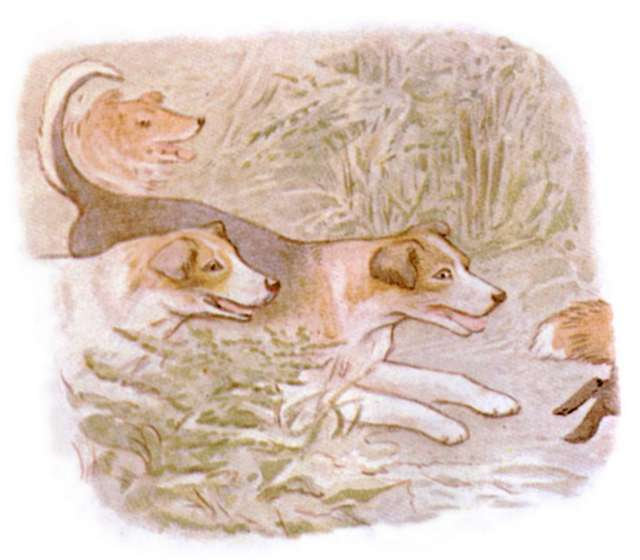
When Jemima came out of the shed both fox hounds jumped in and gobbled all the eggs.

jemima-puddle-duck-beatrix-potter-picture-25

Jemima went home crying.

jemima-puddle-duck-beatrix-potter-picture-26

Sometime later, she lay a new batch of eggs, nobody took them from her and Jemima Puddle-Duck got four little ducklings.

Trivia

  • Beatrix Potter had a real duck named Jemima Puddle-Duck and a sheepdog named Kep.
  • The Tale of Jemima Puddle-Duck is number nine in the series of twenty-three original tales by the same author. All of them are still in print and there are also numerous adaptations to activity books, baby books, gift books, and sound books.
  • The character of Jemima appeared in the ballet Tales of Beatrix Potter, Nick Jr. TV series Peter Rabbit, and in a combination of animated and live movie about Peter Rabbit (the first and most famous character created by Beatrix Potter).
  • The favorite color of Jemima is purple.


red-riding-hood-similar-to-jemima-puddle-duck


Similarity with Little Red Riding Hood


  • The essential plot is the same: the protagonist (Jemima instead of Red Riding Hood) goes into the wood, is tricked by the antagonist (the fox instead of the wolf), and the helper in the end (in this case dogs instead of the hunter).
  • The theme of resurrection is presented by eggs. While in Red Riding Hood the granny and the girl are eaten, to be symbolically born again after the death of the wolf, in The Tale of Jemima Puddle-Duck the first batch of eggs is eaten, and chickens are hatched (born) after the fox escaped.
  • The dog's inquiry about the fox's house is mirroring the wolf's inquiry about the granny's house.
  • The duck's quest for herbs is mirroring Red Riding Hood's flower picking.
  • Naivety of the main characters in both tales are very similar and the messages are too: don't trust a stranger, even if he seems nice.

Here is a chance to refresh the memory of the Little Red Riding Hood and its symbols.

Till next time!


Publicité
15 avril 2023

Oliver Twist, First Edition

Oliver Twist; or, The Parish Boy's Progress, written by Charles Dickens, illustrated by George Cruikshank


Oliver Twist is one of the best works by Charles Dickens and a invaluable treasury of world literature. It tells a story about an orphan who raises from the social bottom to the solid position in the society with an optimistic view on his future. There are numerous interesting aand often grotesque characters in the story which was superbly illustrated by then already well-established caricaturist George Cruikshank.

Oliver Twist was originally published as a serial in Richard Bentley's magazin between 1836 and 1838. Richard Bentley decided to publish the book about Oliver Twist's adventures in three volumes even before the serial came to an end. Charles Dickens who was in the book creditd with his pseudonym Boz, was a very demanding author who was extremely satisfied with Cruikshank's work but asked him to replace the last illustration where the artist portrayed celebration with a contemplating scene.

All illustrations for original Oliver Twist were black and white. Almost one hundred years later, around 1910 an unknown artist colored them what somehow changed the perception of the scenes and characters. On one side everything looks more lively, on the other some edge from Cruikshank's originals are lost.

We will present all 24 pictures from the first edition of Oliver Twist in both versions. Here they are in original order:

Volume 1

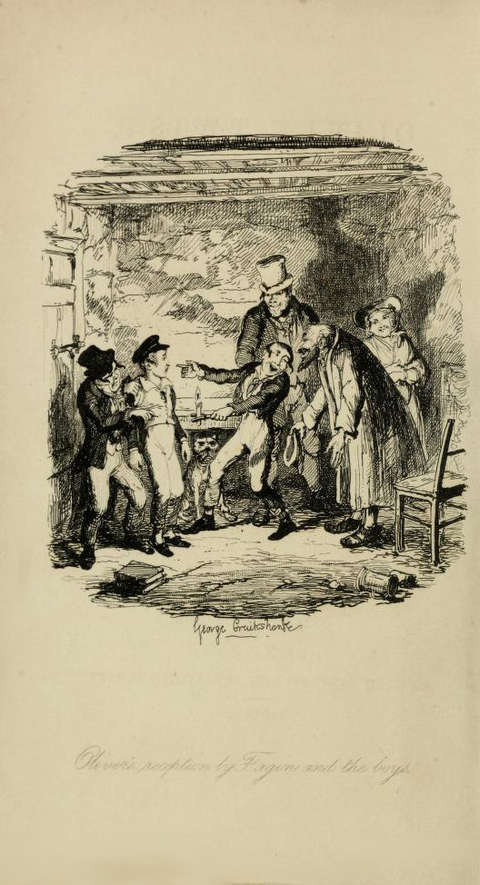
oliver-twist-first-edition-volume-1-illustration-1

Oliver's reception by Fagin and the boys

oliver-twist-first-edition-volume-1-illustration-1-color

oliver-twist-first-edition-volume-1-illustration-2

Oliver asking for more

oliver-twist-first-edition-volume-1-illustration-2-color

oliver-twist-first-edition-volume-1-illustration-3

Oliver escapes being bound to a sweep

oliver-twist-first-edition-volume-1-illustration-3-color

oliver-twist-first-edition-volume-1-illustration-4

Oliver plucks up a spirit

oliver-twist-first-edition-volume-1-illustration-4-color

oliver-twist-first-edition-volume-1-illustration-5

Oliver introduced to the respectable old man

oliver-twist-first-edition-volume-1-illustration-5-color

oliver-twist-first-edition-volume-1-illustration-6

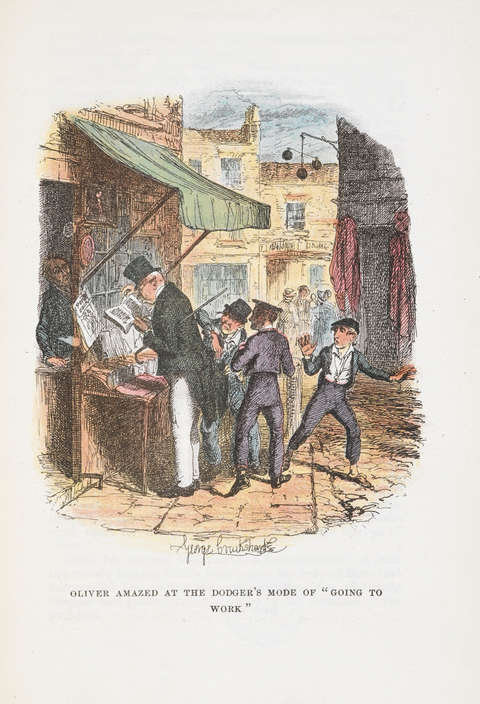
Oliver amazed by the Dodger's mode of "going to work"

oliver-twist-first-edition-volume-1-illustration-6-color

oliver-twist-first-edition-volume-1-illustration-7

Oliver recovering from fever

oliver-twist-first-edition-volume-1-illustration-7-color

oliver-twist-first-edition-volume-1-illustration-8

Oliver claimed by his affectione friends

oliver-twist-first-edition-volume-1-illustration-8-color

oliver-twist-first-edition-volume-1-illustration-9

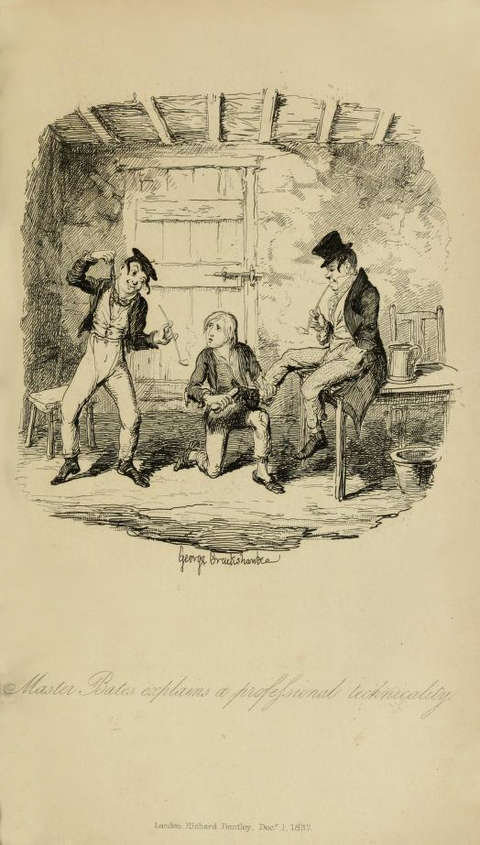
Master Bates explains the professional technicality

oliver-twist-first-edition-volume-1-illustration-9-color

Here the volume one of the book ends. We'll immediately follow with the second one.

Volume 2

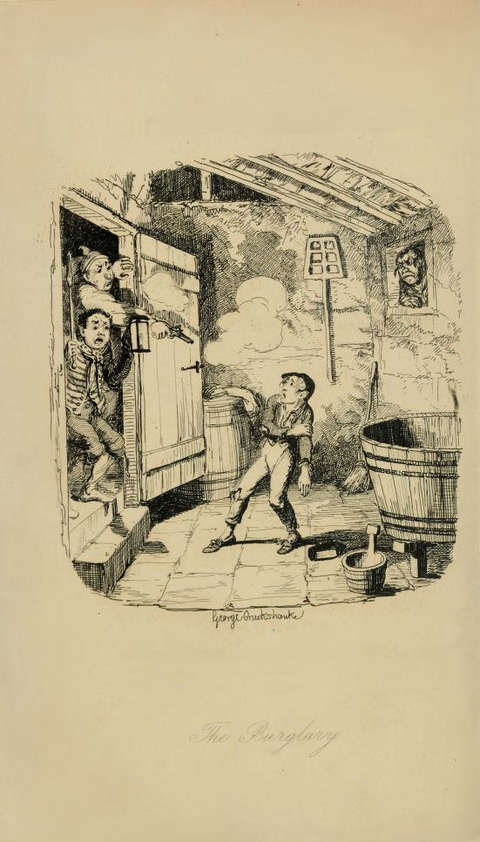
oliver-twist-first-edition-volume-2-illustration-1

The Burglary

oliver-twist-first-edition-volume-2-illustration-1-color

oliver-twist-first-edition-volume-2-illustration-2

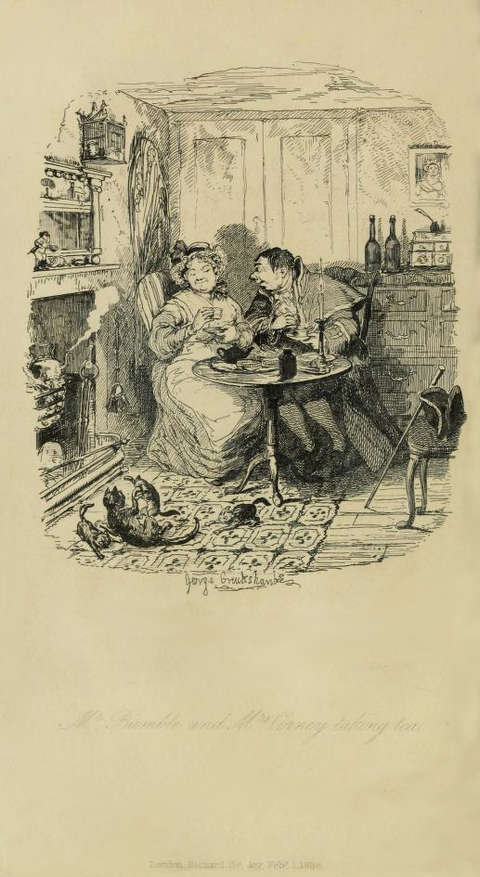
Mr. Bumble and Mrs. Corney taking tea

oliver-twist-first-edition-volume-2-illustration-2-color

oliver-twist-first-edition-volume-2-illustration-3

Mr. Claypole as he appeared when his master was out

oliver-twist-first-edition-volume-2-illustration-3-color

oliver-twist-first-edition-volume-2-illustration-4

Oliver at Mrs. Maylie's door

oliver-twist-first-edition-volume-2-illustration-4-color

oliver-twist-first-edition-volume-2-illustration-5

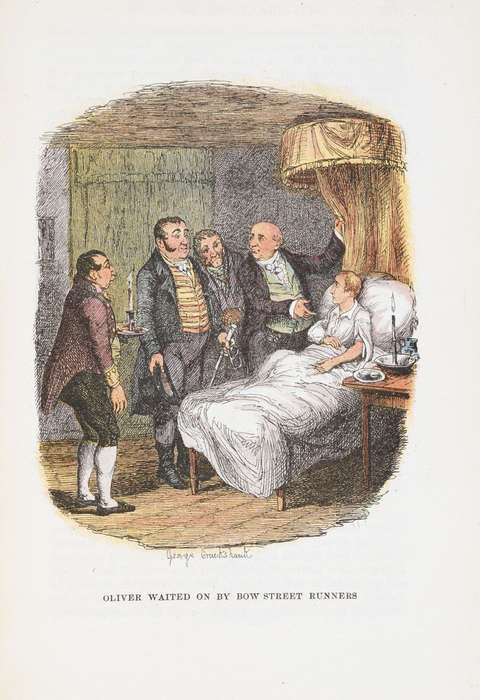
Oliver waited on by Bow Street runners

oliver-twist-first-edition-volume-2-illustration-5-color

oliver-twist-first-edition-volume-2-illustration-6

Monks and the Jew

oliver-twist-first-edition-volume-2-illustration-6-color

oliver-twist-first-edition-volume-2-illustration-7

Fagin in the condemned cell

oliver-twist-first-edition-volume-2-illustration-7-color

While the first volume had nine illustrations, we find only seven in the second one. Next eight illustrations by George Cruikshank are from the third (and last) volume of the first edition of Oliver Twist.

Volume 3

oliver-twist-first-edition-volume-3-illustration-1

The last chance

oliver-twist-first-edition-volume-3-illustration-1-color

oliver-twist-first-edition-volume-3-illustration-2

The evidence destroyed

oliver-twist-first-edition-volume-3-illustration-2-color

oliver-twist-first-edition-volume-3-illustration-3

Mr. Fagin and his pupils recovering Nancy

oliver-twist-first-edition-volume-3-illustration-3-color

oliver-twist-first-edition-volume-3-illustration-4

The Jew and Morris both begin to understand each other

oliver-twist-first-edition-volume-3-illustration-4-color

oliver-twist-first-edition-volume-3-illustration-5

The meeting

oliver-twist-first-edition-volume-3-illustration-5-color

oliver-twist-first-edition-volume-3-illustration-6

Sikes attemping to destroy his dog

oliver-twist-first-edition-volume-3-illustration-6-color

oliver-twist-first-edition-volume-3-illustration-7

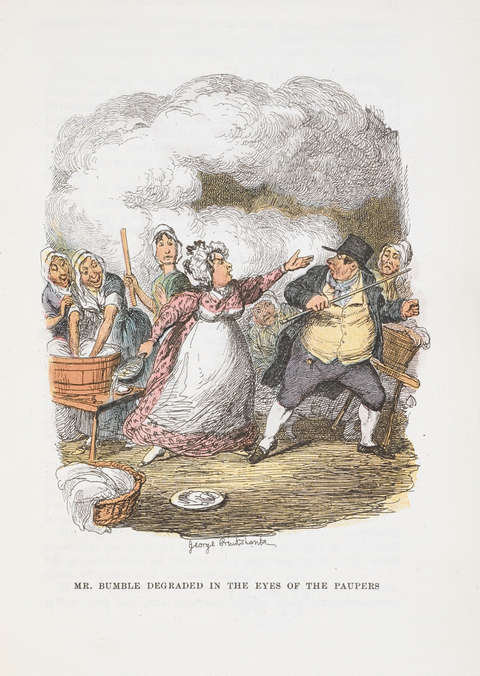
Mr. Bumble degraded in the eyes of th paupers

oliver-twist-first-edition-volume-3-illustration-7-color

oliver-twist-first-edition-volume-3-illustration-8

Rose Maylie and Oliver

oliver-twist-first-edition-volume-3-illustration-8-color

This concludes the last volume of Oliver Twist. While Charles Dickens and George Cruikshank, both giants in their fields of works, collaborated primarily due the simple fact that both worked for Richard Bentley's magazine (Bentley's Miscellany), this book also proved to be a winning combination of the wits of both creators with a sharp eye for details, strong social sense and superb technica mastery of the trade.

Their professional ways parted right after that because Dickens established his own magazine and later Cruikshank began fanatically preaching against drinking and smoking. But that's probably material for another time.

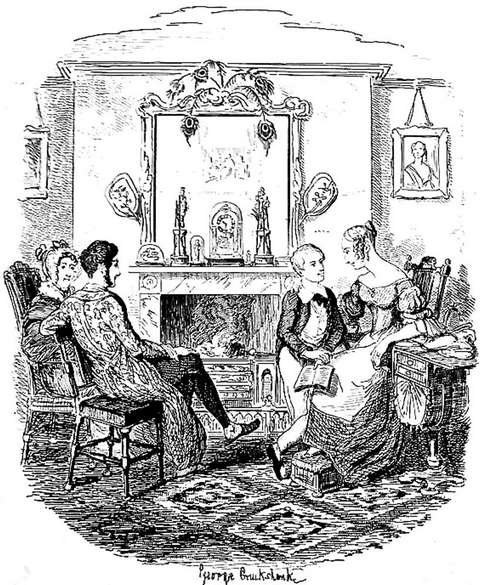
To complete this post, we can also add the illustration which was initially meant for the last scene. George Cruikshank believed Victorian reader's perception of happy ending but Charles Dickens protested against it because he saw it as too conventional. Anyway, the illustration simply called 'fireside plate' found its way to audience and is kind of standrad for collectors' editions.

oliver-twist-fireside-plate

Oliver Twist with the Maylie family; or The fireside illustration

oliver-twist-fireside-plate-color

If by any chance somebody posses the first edition of Oliver Twist, it is worth between thousand and thirty thousand dollars, depending on condition and extras like singnings, binding etc.

31 août 2020

The Carrot Top by Jules Renard and Felix Vallotton

The Carrot Top aka The Carrot Head (originally Poil de Carotte) by Jules Renard from 1902 is a classic work of children's literature that is not so different than today's works by substance yet very different by style. A story about all kinds of humiliating experiences of a kid who doesn't fit in his surrounding (who does?) What leads to all kinds of more or less humiliating experiences is presented in a loose form more resembling series of short sketches than a formal novella.

carrot-top-jules-renard-cover

The kid travels through his miserable (in his opinion) life armed with irony and skepticism, escalating his anger on small animals. Our perception of injustice changed quite a bit since this book was published, so it's hard to relate to his troubles, no matter if we are cursed with red hair and freckles or some other handicap.

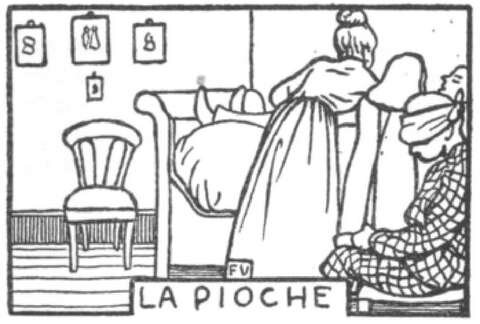
Pierre-Jules Renard (1864-1910), a writer and playwright never hid how very autobiographical his today's most known work really is. The break of his parents' marriage is already presented in the book, just like the toxic relationships between the siblings eventually leading to the decomposition of family structure. Renard eventually dropped out of school, started spending most of his time with friends in cafes, joining forces with journalists and artists, eventually becoming one of them.

carrot-top-jules-fox-01

the hens

carrot-top-jules-renard-02

the partridges

carrot-top-jules-fox-03

it's the dog

carrot-top-jules-renard-04

the nightmare

carrot-top-jules-renard-05

with all due respect

carrot-top-jules-fox-06

the pot

carrot-top-jules-renard-07

the rabbits

carrot-top-jules-renard-08

the deck

carrot-top-jules-renard-09

the rifle

carrot-top-jules-renard-10

the mole

carrot-top-jules-renard-11

alfaalfa

carrot-top-jules-renard-12

the timpani

carrot-top-jules-renard-13

breadcrumbs

carrot-top-jules-renard-14

the trumpet

carrot-top-jules-renard-15

the wick

carrot-top-jules-renard-16

the bath

carrot-top-jules-renard-17

Honorine

carrot-top-jules-renard-18

cooking pot

carrot-top-jules-renard-19

reluctance

carrot-top-jules-renard-20

Agathe

carrot-top-jules-renard-21

the program

carrot-top-jules-renard-22

the blind

carrot-top-jules-renard-23

New Years Day

carrot-top-jules-renard-24

back and forth

carrot-top-jules-renard-25

the pen holder

carrot-top-jules-renard-26

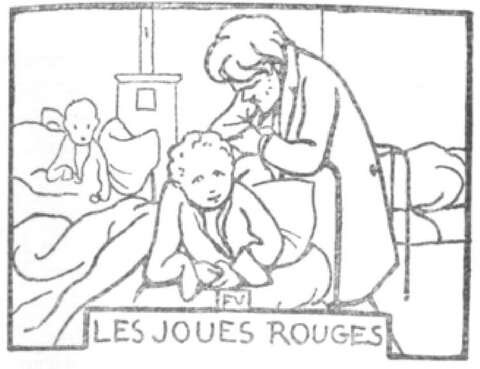
red cheeks

carrot-top-jules-renard-27

the lice

carrot-top-jules-renard-28

like brutus

carrot-top-jules-renard-29

chosen letters

carrot-top-jules-renard-30

the roof

carrot-top-jules-renard-31

the cat

carrot-top-jules-renard-32

the sheep

carrot-top-jules-renard-33

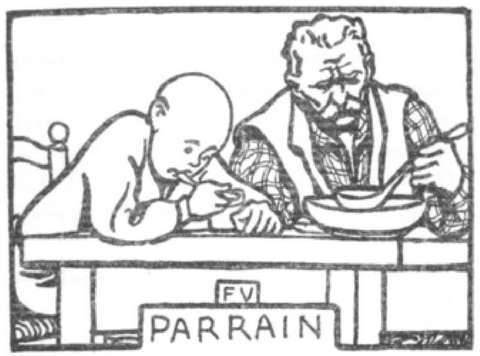
godfather

carrot-top-jules-renard-34

the fountain

carrot-top-jules-renard-35

the plums

carrot-top-jules-renard-36

Mathilde

carrot-top-jules-renard-37

safe

carrot-top-jules-renard-38

tadpoles

carrot-top-jules-renard-39

spectacular turn of events

carrot-top-jules-renard-40

on the hunt

carrot-top-jules-renard-41

the fly

carrot-top-jules-renard-42

the first woodcock

carrot-top-jules-renard-43

the hook

carrot-top-jules-renard-44

the silver coin

carrot-top-jules-renard-45

personal ideas

carrot-top-jules-renard-46

leaf storm

carrot-top-jules-renard-47

the revolt

carrot-top-jules-renard-48

the final word

carrot-top-jules-renard-49

the carrot top album

carrot-top-jules-fox-vignette

The story about the Carrot Head was adapted for theater, and later the play further adapted for the novella, this time with already grown-up Red Head. Several movies were made after it as well. We present the original illustrations from the first edition, done by Felix Edouard Vallotton (1865-1925) a painter of Swiss-French origin, who was specialized for modern woodcuts. His style with huge areas of black and white, with emphasized borders, fits perfectly with the story.

Just a note: carrot top is just one of numerous sometimes pretty derogatory nicknames for a read-heads. If you are interested to find out moe of them, here is a list of nicknames for people with red hair.

20 avril 2020

The Old Nursery Stories with illustrations by William Henry Margetson

The Old Nursery Stories by E. Nesbit, illustrated by WH Margetson

E. Nesbit is, of course, a pen name for Edith Nesbit who was at the time of publishing of the book already married (her surname was Bland), a mother of five (two adopted), and a well-known author of dozens of books. She wrote many, she collaborated on even more, and this one is an example of her retelling and editing skills. By the way, the book is dedicated to her youngest son (adopted, his real mother was the Bland's housekeeper, secretary and long time Edith's husband mistress Alice Hoatson) John.

the-old-nursery-stories-e-nesbit-wh-margetson-cover

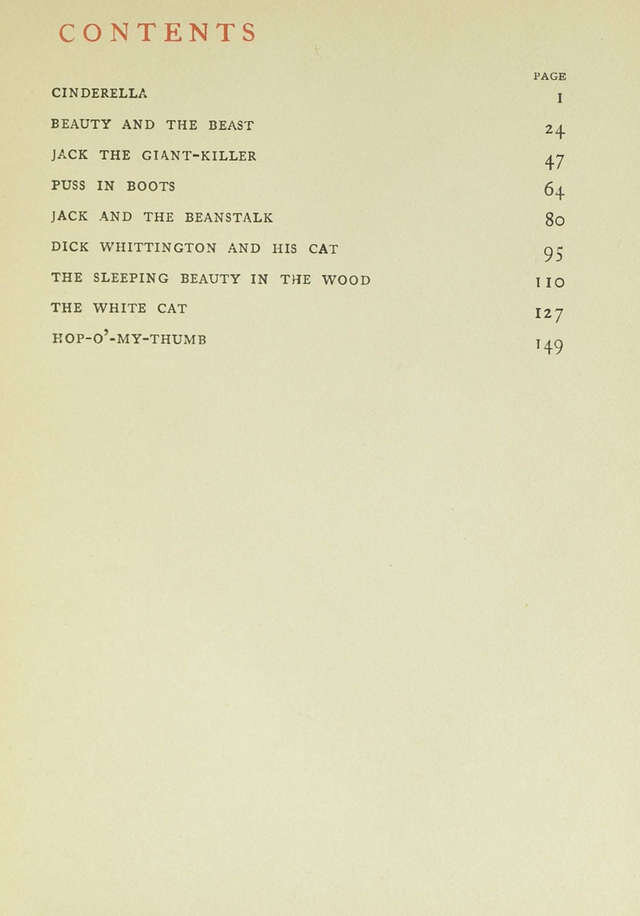
It's a collection of nine all-time classics, among which Dick Whittington and his cat and The white Cat are almost forgotten now, yet we'll spend a few lines to each one of them, especially enjoying in pictures by William Henry Margetson, who was more of a painter than an illustrator by profession. However, he did a great job on this book and we are lucky to find it and preserved for posterity.

the-old-nursery-stories-e-nebit-wh-margetson-inside-title

We are less enthusiastic about the adaptations of the stories. Mrs. Nesbit who was prolific in writing for adults too was a fan of literary realism (a socialist by political belief), an author who is credited as a pioneer, if not an inventor of a much more realistic approach to the literature for kids. Her interventions in these timeless texts are more disturbing than enriching, often weakening the basic plot or message (s), despite some humorous additions.

the-old-nursery-stories-e-nesbit-wh-margetson-contents

So we'll focus on the illustrations instead. Each one of them is originally accompanied by a line, related to the place in the story, and we included those lines (in italics) as well. They are done in war aquarelle colors, with a loose brush, using the methods of pre-raphaelites and post-impressionists. Just an interesting tidbit - the bok was published in the same year Mr. Margetson became a member of the Royal Institute.

Cinderella

wh-margetson-cinderella-1


She sat down in the quiet kitchen among the gray ashes, and cried and cried (used as frontispiece)

The story about the girl who lost everything, was degraded almost to the status of the beggar but became the princess and has so big heart, she forgives her stepsisters too.

wh-margetson-cinderella-2


No one had passed out except a ragged beggar girl, running like a mad thing

Beauty and the Beast

wh-margetson-beauty-and-the-beast-1


Then he burst into tears

Another well-known fairy tale with riches-to-rags-to-riches plot. This time the youngest girl offers to sacrifice herself to save the father only to find out sometimes the real beauty lies deep below the horrifying appearance.

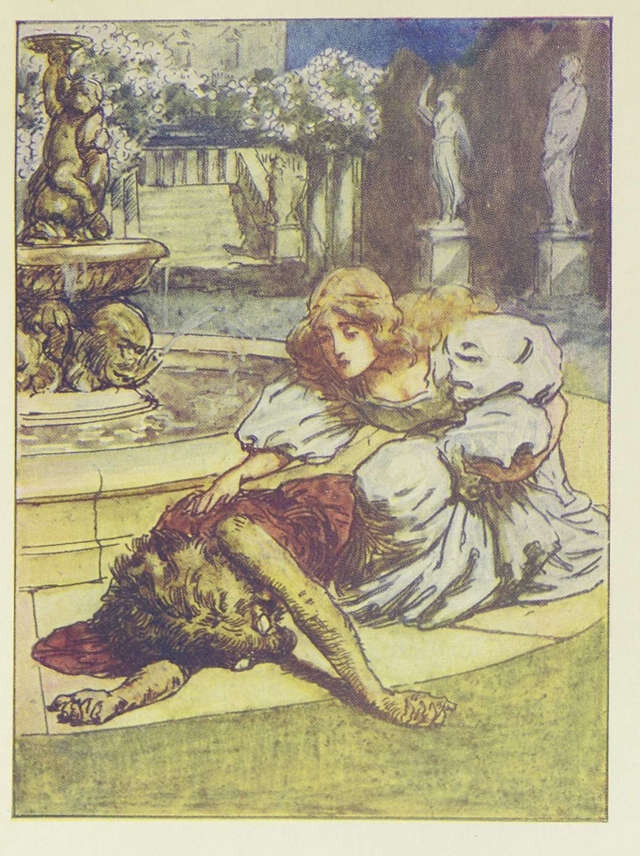
wh-margetson-beauty-and-the-beast-2


In a moment she was leaning over it. It was the Beast

We have already dedicated a full post to the story about Beauty and the Beast, illustrated by William H. Thwaites.

Jack the giant-killer

wh-margetson-jack-the-giant-killer


The giant ran clumsily after him

There was a Jack, a brave young man, who decided to clear the world of cruel, violent and cannibalistic giants.

Puss in Boots

wh-margetson-puss-in-boots


The cat stood up in his boots with the yellow heels and put his paws to his mouth and shouted

A story about the boy who inherited only a cat, while his brother got a mill and a donkey. But the cat was not an ordinary cat ...

We can go through the whole story with many more color illustrations in the next post:

Puss in Boots, by Richard Andre

Jack and the beanstalk

wh-margetson-jack-and-the-beanstalk


She stood looking up after him

Another story about a boy named Jack, this time dealing with one giant only, but he must visit him three times before their conflict is resolved.

Dick Whittington and His Cat

wh-margetson-dick-whittington-and-his-cat


On his doorstep the owner of the house ... found him in the morning

A story with several elements similar to Puss in Boots, but more realistic. It is believed it is a fairy retelling of the life-story of legendary London major Richard Whittington.

We have already presented a collection with this story, where you can find more info:

Told in the Twilight

The Sleeping Beauty in the Wood

wh-margetson-the-sleeping-beauty-in-the-wood-1


"What are you doing, good lady?" the Princess asked

We are all familiar with a curse leading to one hundred years long sleep. It's interesting to note Nesbit 'corrected' the dramatical failure by Brothers Grimm who 'forgot' to punish the wicked fairy. Here, she hears about Sleeping Beauty and her prince's happiness what makes her so angry she dies!

wh-margetson-the-sleeping-beauty-in-the-wood-2


There on the carved ebony bed lay the Princess

The White Cat

wh-margetson-the-white-cat


A little person ... veiled in black lace, walked with slow dignity towards him

This is probably least known of all fairy tales included in the book. It is written by Madame d'Aulnoy, the woman who invented the term fairy tale, and, as you may presume, wrote a few fairy tales on her own. This one is pretty similar to Beauty and the Beast, but with a twist - a prince meets a cat who is, of course, an enchanted princess.

Hop o 'My Thumb

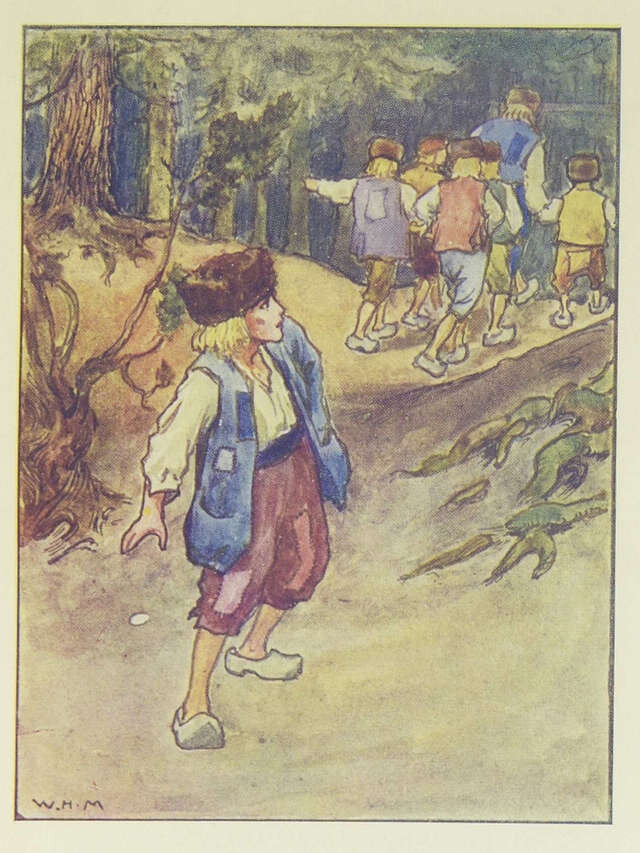
wh-margetson-hop-o-my-thumb


Hop-o'-my-Thumb lagged behind, and every ten paces he dropped a white stone

Another almost forgotten fairy tale, with a small boy with a big heart and even more brains, who saves his six brothers, tricks a giant and made his family rich and happy.

the-old-nursery-stories-e-nesbit-wh-margetson-back

That's it. The Old Nursery Stories was published by Henry Frowde and Hodder & Stoughton in London in 1909.

17 septembre 2019

Geneva Window, the Scandalous Stained-Glass Masterpiece by Harry Clarke

It was June 1925 when representatives of the Irish Department of Industry and Commerce approached Harry Clarke with the idea of designing a stained glass window for the International Labor Court in Geneva as a gift of the newly established Irish state. Clarke was already an established illustrator by then and one of the most famous designers of stained glass in the world.


harry-clarke-artist-photo


The initial idea came from Miss Brighid Stafford, but this offer was not the only one coming from Ireland. They also suggested a carpet, a painting, and a work in Irish marble. Thanks to the fact Germany already donated stained glass to the same organization, Clarke’s window was not the favorite, yet the idea was eventually accepted by authorities in Geneva.


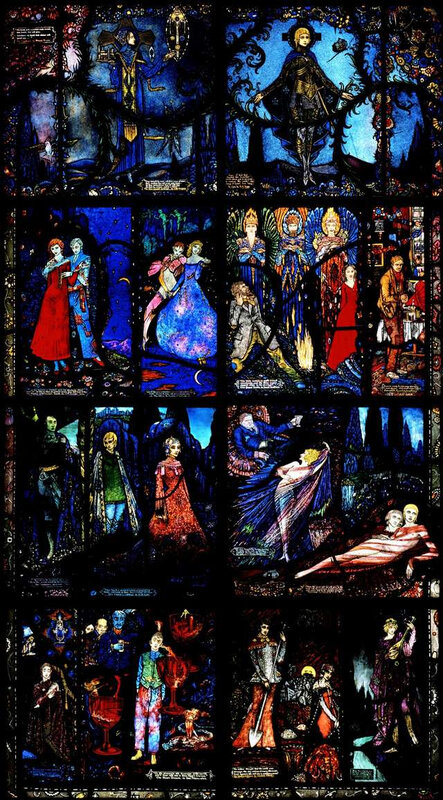
The window should present scenes from the most well-known pieces of Irish literature. Clarke and William Butler Yeats suggested 15 authors and work to be included and the list was confirmed in 1927 by the government. The project took Clarke and his studio for about two years. It was about to be finished when his health worsen so seriously he had to visit a sanatorium in Switzerland. His best men in the studio were left with detailed instructions to finish the project.
 

geneva-window-harry-clarke


His health worsen so much the project was delayed for a full year but at least he managed to finish the last corrections by himself. He framed the window in with 71,5 inches by 40 inches dimensions hoping it will be installed during next weeks. It never came to Geneva.


During all the phases there were already numerous challenges during the work, mostly thanks to innovative yet challenging Clarke’s technique. His usage of acids and lead led to extremely attractive effects caused by colors and light. Presented characters were glowing, sometimes looking like surrounded by flames, like they are not of this world. Considering different phantasy, legendary, and religious scenes were involved, the aim of the artist was obvious.


geneva-window-panel-6-cracked

(This part (panel 6) for instance, cracked at final firing. It was edited later and the scene didn't enter the final design.)

On the other side glass treated under such intense conditions became very fragile and cracks were expected in any phase, especially in later ones. Addition of numerous decorative elements (Henry Clarke was still a member od Art Nouveau movement) and quotes from literary works with inscriptions made the panels even more sensitive to all kinds of stress.

Working with highly hazardous materials which eventually caused health issues and death of Clarke (and several other stained art artists from his era) was another undesirable side effect. At first, his eyes were losing sight, then he felt of the bike, getting many injuries, then he was diagnosed tuberculosis. He died just being 41 years old.

But none of these problems caused so serious obstacle as the political attitude towards the scenes depicted. Fifteen scenes from the same number of works and authors were selected and confirmed by Minister Patrick McGilligan. It took politicians several years to authorize the sketches done by the artist who was understandably excited with a possibility to exhibit his work in such a prestigious location. Then, when they finally settled with the project, they wanted it as soon as possible.

Clarke did his best, but he was already loaded with other work and replied he needs about half a year to finish it. When the Geneva window was finally done, the criticism on the depicted scenes (remember, there were fifteen of them) started:


  • Synge’s The Playboy of the Western World already had to be altered in the sketch phase.
  • O’Sullivan’s The Others was also met with criticism as it may cause misunderstandings and offense.
  • President Cosgrave also suggested the panel presenting Mr Gilhooley by Liam O’Flaherty to be replaced because it looked too provocative.
  • According to Gordon Campbell (as the Secretary of the Department of Industry and Commerce he was already involved with the project from the very beginning right to the approval stages) even the selection of censored Joyce on the panel number 15 was not acceptable.


This means all Clarke’s hard work was heavily criticized despite all efforts he made before and during the process of planning, making constricting and editing the Geneva Window. He tried to save the project with a suggestion of several alternatives which should be presented in the meeting but such a meeting never happened. He died before the window was accepted and when it was, it wasn’t sent to Switzerland but installed in Merrion Street in one of the Government Buildings.

Clarke’s widow Margaret, an established painter herself bought it back next year (for the same price as received) but it was not immediately returned. The first crack in the window appeared in 1932 and the second in 1933. After that, the window was returned to Clarke’s studios to be repaired and it stayed in the family for several decades.

After Margaret’s death, the Geneva window was lent to Dublin’s Municipal Gallery of Modern Art where it was exhibited from 1963 to 1980. Then it was decided to be relocated - to the storage room. Harry Clarke’s sons took it back. In 1988 it was exhibited again, this time through the Fine Art Society in London when an art collector Mitchell Wolfson offered to buy it for his collection. The price was 100 hundred thousand British pounds.

This very special piece of art finally found a home at Wolfsonian Foundation at the University of Florida, Miami, where it’s permanently displayed.


Panel 1


geneva-window-panel-1


The Wayfarer by Patrick Pearse


The beauty of the world hath made me sad

This beauty will pass,

Sometimes my heart hath shaken with great joy


(These verses were written on the eve of Pearse’s execution, what is represented with a black plate where the inscription is written, surrounded by flowers.)


The Story brought by Brigit (A Passion Play in Three Acts) by Lady Gregory


They bruised His brow with their crown of briars;

They mocked Him with every ugly thing;

He that could have shrivel them all with fire

He held His silence and He is a King


(The play was first performed at the Abbey Theatre in 1924.)


Panel 2


geneva-window-panel-2


Saint Joan (A Chronicle Play in Six Scenes and an Epilogue) by George Bernard Shaw


O God that made this

beautiful earth,

When will it be ready

to receive thy Saints;

How long, O Lord, how long?


(The play was first published in 1921, right after the martyr and so-called Warrior Saint was canonized. She is presented with short hair-cut, surrounded by decorative flowers and leaves, waiting for execution, already slightly floating above the ground.)


Panel 3


geneva-window-panel-3


The Playboy of the Western World by John Millington Synge


Well the heart’s a wonder; and I’m thinking there

won’t be our like again in Mayo, for gallant lovers, from this hour today


(The controversial theatre play was first published in 1907, the chosen scene is showing lovers in the moonlight just before the tragic incident.)


The Others by Seumas O’Sullivan


And now they pause in their dancing

And look with troubled eyes,

Earth’s straying children

With sudden memory wise


(The poem was published in Padraic Colum’s Anthology of Irish Verse in 1922, don’t miss the dancing elves above the lovers.)


Panel 4


geneva-window-panel-4


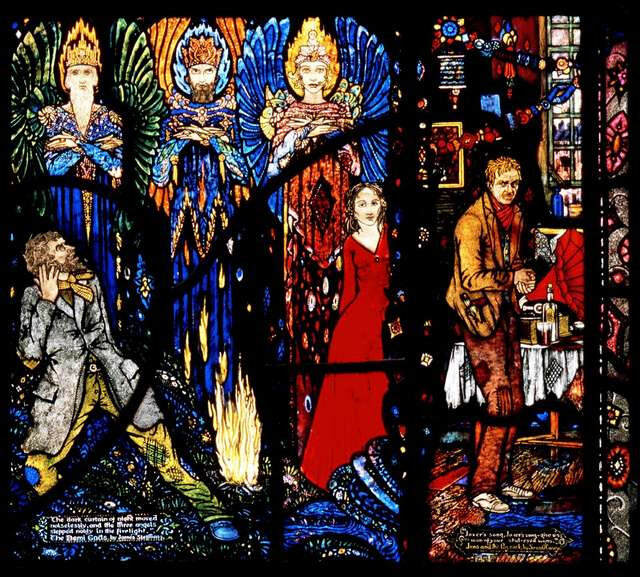
The Demi-Gods by James Stephens


The dark curtain of night moved noiselessly,

and the three angels stepped nobly in the firelight

(The novel was published in 1914, the scene with three angels is from the second chapter of the first book.)


Juno and the Paycock by Sean O’Casey


Joxer’s song, Joxer’s song – give us

wan of your shut-eyed wans


(The play was staged in Dublin in 1924 for the first time, the depicted scene shows Captain Boyle asking Joxer to sing his favorite song.)


Panel 5
 

geneva-window-panel-5


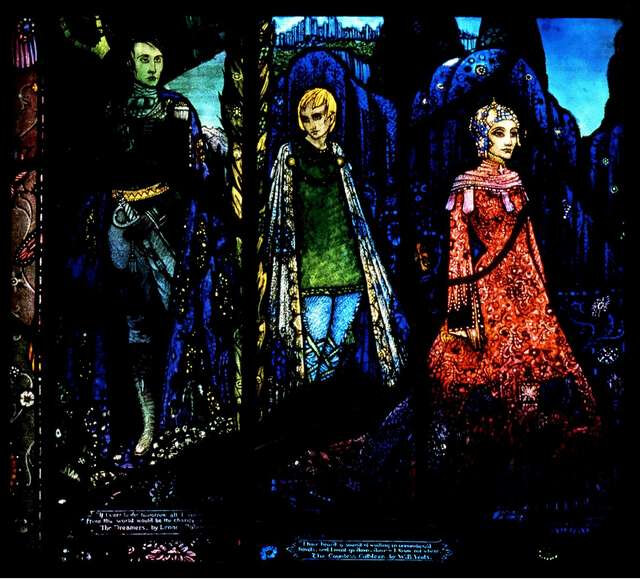
The Dreamers by Lennox Robinson


If I were to die tomorrow, all I would ask from the world

would be the charity of its silence


(We can see the figure of Robert Emmet in the last of this 3-act play from 1915 when he is saying he can’t leave Ireland.)


The Countess Cathleen by William Butler Yeats


I have heard a sound of wailing in unnumbered

hovels, and I must go down, down, I know not where


(The song from 1892 is telling the story about the title character who is willing to sell her soul for saving her residents from hunger. The influence of Ballets Russes is clearly visible in her blue, purple, and red outfit.)


Panel 6


geneva-window-panel-6


Mr Gilhooley by Liam O’ Flaherty


She came towards him dancing, moving the folds of the veil

so that they unfolded slowly as she danced


(The sentence from the censored novel was published in Chapter XI in 1926 and is part of the scene where the main characters are both drunk and ’indecent’.)


Deirdre by George (AE) William Russell


I know the great gift we will give to the

Gael will be a memory to pity and sigh

over: and I shall be the Priestess of Tears


(The scene from the second act of the three-act drama, first performed in 1902 and published in 1907 presents the title character with her lover Naisi in the wood.)


Panel 7


geneva-window-panel-7


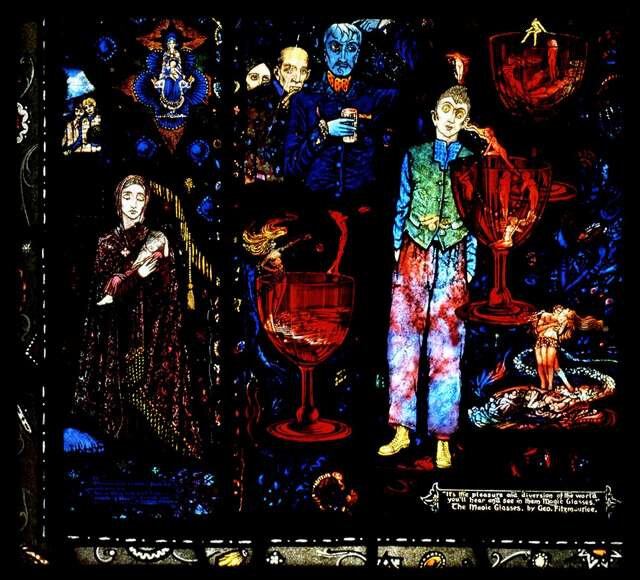
A Cradle Song from Wild Earth by Padraic Colum


Mavourneen is going from me and from you,

Where Mary will fold him with mantle of blue


(The song was first published in 1907, Arnold Bax set it to music in 1922. Please note the Virgin Mary and Child protecting the worried mom and her baby.)


The Magic Glasses by George Fitzmaurice


It’s the pleasure and diversion of the world

You’ll hear and see in them magic glasses


(The scene from the play, first performed in 1913, focuses on the three magic red glasses, representing women.)


Panel 8


geneva-window-panel-8


The Weaver’s Grave by Seamus O’Kelly


The widow thought that the world was

strange, the sky extraordinary, the man’s

head against the red sky a wonder, a poem


(The scene from a short story from 1919 presents a young widow with a gravedigger behind her. There is a silhouette of two more gravediggers as a contrast to the golden sun.)


On Music from Chamber Music by James Joyce


There’s music along the river

For love wanders there

Pale flowers on his mantle

Dark leaves on his hair’


(The mandolin player is a personification of the verse from 1907. This panel is signed with Harry Clarke Dublin 1930.)


15 février 2019

Told in the twilight (stories to tell to children) with illustrations by Blanche McManus


blanche-mcmanus-told-in-the-twilight-cover

There are ten stories for children altogether in the book, each of them accompanied with a line illustration by Blanche Mcmanus.

blanche-mcmanus-told-in-the-twilight-endpaper-1

We'll present the stories with very short summaries and pictures by Blanche McManus.

blanche-mcmanus-told-in-the-twilight-inside-title

Undine, the water maid, who wedded a mortal

blanche-mcmanus-told-in-the-twilight-undine

Undine is a story about a water spirit who must marry a human to get an immortal soul. While human - a knight - falls in love with her at first, another girl comes into the picture. Undine discovers his infidelity and decided to punish him.

Undine inspired numerous artists for centuries. Here is a full site dedicated to the legend of Undine:

https://undine.webs.com

Rip van Winkle and his long nap

blanche-mcmanus-told-in-the-twilight-rip-van-winkle

Rip would be a perfectly happy man if only his wife would not be so annoying. He had long walked with his dog to enjoy at least some piece as often as possible until he met a group of strange looking men. They gave him a drink after which he slept for more than twenty years. When he woke up, he was old, his dog was old and everything in his environment changed. But at least his wife was already dead...

The swineherd

blanche-mcmanus-told-in-the-twilight-the-swineherd

It's a fairy tale by Hans Christian Andersen. There is a king, who is not very rich, but thoughtful and a princess who is beautiful but senseless. She loves toys and can't appreciate natural beauty. The king finds a way to her heart only to find out he doesn't want a wife with such a cold heart.

Dick Whittington and his cat

blanche-mcmanus-told-in-the-twilight-dick-whittington

This story is grounded on real people and events, namely on Richard Whittington (1354-1423) who was a Lord Mayor of London (for four times!) and one of the people who made not only an important impact on the development of the city but the progress of society as well. The story is representing him as a poor boy who becomes powerful and affluent with a help of his cat and hard work, somehow resembling more know fairy tale Puss in Boots.

Presentation of the picture book with engravings by legendary George Cruikshank and additional info on the story can be seen here:

http://vintagebooks.joomla.com/8-fairy-tales/4-dick-whittington-his-cat

The dragon of Wantley

blanche-mcmanus-told-in-the-twilight-the-dragon-of-wantley

The poem about the dragon of Wantley is almost forgotten today. Yet it was very popular a few hundred years ago. It's a classic story about a horrible dragon and a knight but with a satirical approach, more comic than terrifying. It was adapted for theater and opera stages and published in a form of a novel too. This version is adapted to the youngest audience.

A voyage to fairyland

blanche-mcmanus-told-in-the-twilight-a-voyage-to-fairyland

Dora is a girl who likes stories about fairies. Of course, she doesn't believe in magical beings. She is too grown up for this. Until one evening a goblin invites her on the voyage to Fairyland...

The ugly duckling

the-ugly-duckling

Another fairy tale by Andersen. A duck who is despised by his own family and just about everybody in his environment is so unhappy he even wants to die in one moment. Then he realized he is not really a duck but something much more magnificent. This story bears many similarities with the author's own life.

Robin Hood and his merry men

blanche-mcmanus-told-in-the-twilight-robin-hood

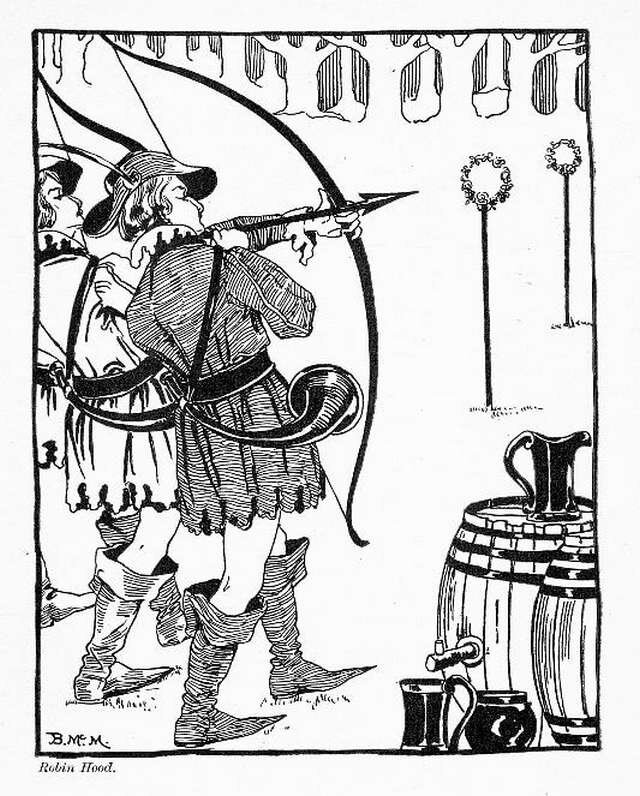
In a shortened version of Robin Hood we meet only some of the major characters and see a few examples of Robin's business - he invites travelers to dinner and accepts their 'voluntary' participation in money and other goods. In case, somebody can't afford the payment, he even lent money to such guests thus expanding his circle of friends and supporters.

His fame was so great the king arranged a meeting and, enthusiastic by Robin and his men, invited all of them to serve in court. They accepted but after a while, they all realized their true calling lies in the forest where they lived for the rest of their lives.

The discontented pendulum

blanche-mcmanus-told-in-the-twilight-the-discontented-pendulum

There was an old clock, working steadily for years when it suddenly stops. The pendulum complained about his tiredness - he calculated how many ticks he had already done in many years of working and is decided to take some rest. Other parts of the clock encouraged him to get back to work and then he really started swinging again, one swing at a time - even faster than before.

The pied piper of Hamelin

blanche-mcmanus-told-in-the-twilight-the-pied-piper-of-hamelin

In the town of Hamelin, there were so many rats people started believing they'll never get of rid them. Then a piper offered himself to take care of rats. When he led them out of the town with a help of his magic pipe, people of the Hamelin forgot what they promised. They didn't want to pay him anymore. So the piper took his pipe again and led the children out of town.

A detailed presentation and analysis of Pied piper can be read here:

https://hubpages.com/education/pied-piper

With this story the book Told in the twilight (stories to tell to children), illustrated by Blanche McManus (1869-1935) and published by E. R. Herrick & Company approximately in 1898, ends.

Publicité
1 2 3 > >>
Art You Should Know
Publicité
Archives
Publicité